







From Individual Productivity to Institutional Engineering Leverage
AI‑powered coding agents matured rapidly through 2025 and into 2026, marking an inflection point in how software is built. What began as a set of powerful personal productivity tools for individual developers has crossed an important threshold. Coding agents are now capable of contributing meaningfully across larger portions of the software development lifecycle, including the ability to safely modify and refactor code across substantial portions of a codebase, reason across architectural boundaries, and iteratively correct their own output in well-scoped environments. Organizations that have embraced these capabilities are seeing real and repeatable gains in speed, throughput, and developer effectiveness.
At the current moment, this value in large enterprises mostly remains localized to individual contributors. Engineering teams regularly apply coding agents as point accelerators that boost personal productivity but do not fundamentally change how organizations operate. While these gains are material, they represent only a fraction of the opportunity. The real prize in 2026 is not faster code, but scalable and explainable engineering leverage across teams, systems, and portfolios.
So-called “vibe coding” can scale output, but it does not scale understanding. When teams rely on AI to generate code without first establishing clear intent, constraints, and architectural boundaries, the codebase itself becomes the de facto specification. In enterprise environments where systems must endure, security and compliance matter, and ownership spans multiple teams, this introduces unacceptable long-term risk. Velocity increases, but clarity erodes.
This post argues that the next step in AI-enabled software development is Specification-Driven Development with AI (SDD). In this model, specifications become first-class assets: explicit, reviewable, and versioned expressions of intent and constraints that guide and govern implementation. Code is no longer the primary medium for negotiating requirements or architectural decisions. Instead, teams can generate, regenerate, and evolve the outcome as their understanding improves.
The shift from coding assistants to SDD represents more than a tooling upgrade; it is an operating-model decision. As AI dramatically reduces the cost of writing code, clarity rather than code becomes the scarce resource.
Coding agents, therefore, need a new engineering control model. One that preserves the speed and capability AI enables while restoring intentionality, governance, and explainability at scale. This post examines why 2026 marks this transition, identifies where current approaches fall short in enterprise settings, and argues that organizations that prioritize clarity of intent will be best positioned to build systems that endure.
Coding Agents Have Become Viable Co-Producers
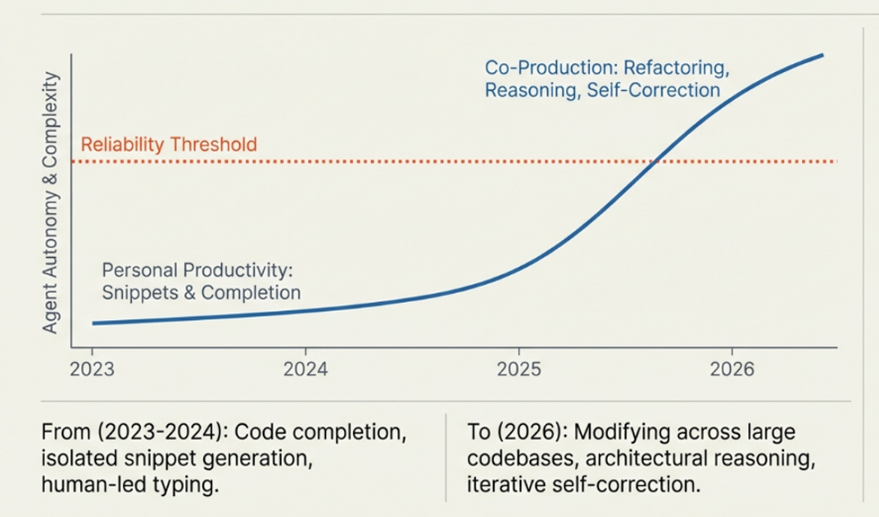
Through 2025 and into 2026, AI-powered coding agents crossed an important capability threshold. They are no longer confined to isolated tasks like completing code or generating snippets. In well-scoped environments, modern agents can safely modify and refactor code across substantial portions of a codebase, reason across architectural boundaries, and iteratively diagnose and correct their own output. This shift changes the role AI can play in software development from assistant to viable co-producer.
For technology leaders, the significance of this change lies not in any specific tool or model, but in what it enables. Developers increasingly act as reviewers, decision-makers, and orchestrators of work rather than primary authors of every line of code. AI handles more of the mechanical aspects of implementation, while humans focus on intent, trade-offs, and correctness. As a result, the center of gravity in software development is moving up the stack.
At AIS, we have seen this shift consistently across delivery engagements. Productivity gains from coding agents are real, repeatable, and compounding. Teams are not only writing code faster, but accelerating design exploration, test generation, documentation, and large-scale modernization efforts that would previously have required significantly more time and coordination. In several cases, scope that once demanded large teams has become achievable by a smaller number of highly leveraged engineers.
Importantly, this is not about replacing developers. It is about changing the unit of leverage. As implementation becomes cheaper and more abundant, delivery depends less on how quickly teams can write code and more on how clearly they can express, communicate, and maintain intent over time. When agents operate within strong contextual grounding such as architectural constraints, domain knowledge, and security boundaries, they amplify human judgment rather than obscuring it.
This capability shift sets up a broader organizational question. If AI can now produce code at scale, what should guide that production? Answering that question requires moving beyond ad-hoc tool adoption toward a more deliberate control model, one that treats intent and constraints as primary inputs rather than afterthoughts.
Enterprise Reality Check: Why Vibe Coding Breaks at Scale

AI-enabled “vibe coding” has proven to be an effective technique in the right contexts. When scope is small, ownership is local, and a system’s lifespan is short, teams can iteratively prompt coding agents to generate and refine code, achieving impressive velocity. In these scenarios, rapid experimentation and low friction often outweigh the cost of misalignment, and course correction remains manageable.
In enterprise environments, however, this same approach introduces unacceptable risk.
When systems must endure, integrate with existing platforms, meet security and compliance requirements, and be operated by multiple teams over time, relying on code as the primary expression of intent breaks down quickly. Architecture must persist. Ownership changes. Decisions compound. Under these conditions, the absence of explicit, shared intent becomes a liability rather than a convenience.
Several failure modes appear consistently. Architecture emerges accidentally rather than deliberately, shaped by incremental agent outputs instead of principled design. When teams make early implementation choices before they fully understand requirements and trade‑offs, they lock themselves into structures, patterns, and assumptions that are hard to unwind. As context shifts across prompts, teams apply security controls unevenly, creating gaps that are difficult to audit or explain. Over time, systems may function, but they become increasingly opaque, fragile, and resistant to safe evolution.
The core issue is not the quality of the code that AI produces. In many cases, the code itself is clean and correct. The problem is that intent remains implicit. When teams do not articulate and negotiate intent up front, the codebase becomes the de facto specification. Code, however, is among the worst possible places to reason about requirements, revisit architectural decisions, or align across teams once systems reach meaningful scale.
In practice, output increases while clarity erodes. Short-term velocity masks long-term fragility. What begins as a fast path to delivery often results in higher operational costs, increased risk, and slower change over the life of the system. For organizations operating at scale, this trade-off is rarely acceptable.
This reality does not diminish the value of coding agents. Instead, it clarifies the need for a different control model, one that preserves the speed AI enables while restoring shared understanding, governance, and intentionality across the organization.
Code Is a Poor Medium for Strategic Decision-Making

Code is an exceptional medium for implementation. It is precise, unambiguous, and directly interpretable by machines. These qualities make it (obviously) indispensable for building software. They also make it poorly suited for negotiating intent, exploring alternatives, or evolving strategic decisions.
Once written, code becomes a binding artifact. Architectural choices, dependency structures, vendor integrations, security assumptions, and non‑functional characteristics harden quickly, even when teams make them implicitly or prematurely. Reversing these decisions later is rarely a simple technical exercise. It often requires coordinated rewrites, cross-team alignment, and difficult trade-offs that carry genuine cost and organizational friction.
This creates a fundamental tension between decision velocity and the ability to change a decision. Writing code early can feel like progress because it produces visible output and rapid feedback. When requirements are still emerging, however, that speed comes at the expense of flexibility. The faster implementation moves ahead of understanding, the more expensive it becomes to change course. What begins as an engineering decision can quickly become a political one as sunk cost and delivery pressure limit viable alternatives.
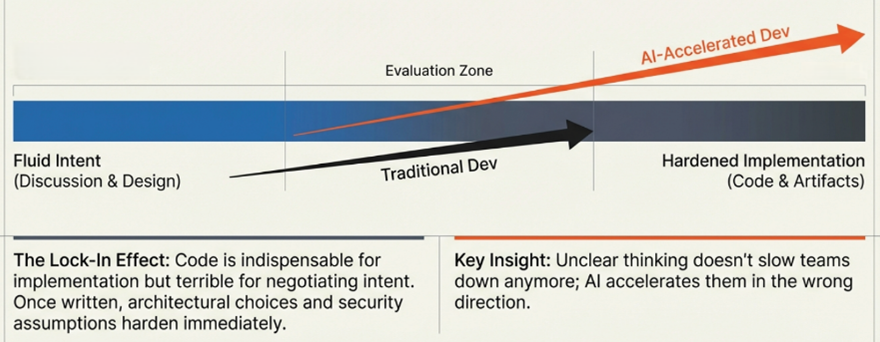
AI intensifies this dynamic. As coding agents dramatically reduce the effort needed to generate working implementations, teams find it easier than ever to commit to solutions before fully forming the underlying intent. In this environment, unclear thinking does not slow teams down. It accelerates them in the wrong direction. The result is not faster learning, but faster lock-in.
If AI makes writing code cheap, then clarity becomes the scarce resource. Teams must make strategic decisions about architecture, boundaries, and constraints in a medium that supports discussion, review, and evolution without prematurely binding themselves to a specific implementation. Code, by its nature, is the wrong place to do this work.
Recognizing this limitation is not an argument against AI-assisted development. It is a prerequisite for using it effectively om systems that must scale and evolve over time. As implementation becomes abundant, organizations must deliberately separate the work of deciding what to build from the work of building it. Doing so creates the conditions for speed without sacrificing control, a balance that becomes increasingly critical as systems grow in scale and complexity.
Specification-Driven Development (SDD): A Better Control Plane

Specification-Driven Development (SDD) is a pragmatic operating model that addresses a core limitation exposed by mature coding agents: the growing mismatch between inexpensive implementation and the inflated cost of unclear intent. Instead of treating specifications as secondary documentation or a development byproduct, SDD elevates them to first‑class engineering assets that explicitly define what is being built, why it matters, and the constraints it must operate within.
At its core, SDD separates concerns that are often conflated in practice: intent defines the problem being solved and the outcomes being sought, while constraints establish the architectural, domain, security, and operational boundaries that must be respected. Implementation becomes an outcome of these inputs rather than the primary vehicle for discovery. This separation allows teams to reason, review, and evolve decisions before they become embedded in code.
This shift is best understood as a control-plane decision. Much like when Infrastructure-as-code (IaC) introduced a declarative layer that made infrastructure repeatable, auditable, and easier to evolve, Specification-Driven Development provides a similar layer for application engineering. It defines how decisions are made, reviewed, and evolved across teams without prescribing any specific tool, language, or platform.
In an SDD model, specifications serve multiple roles simultaneously. They provide a shared source of truth for stakeholders, a durable record of architectural and design rationale, and a structured input to coding agents. By capturing the “why” behind technical choices, not just the “what,” specifications make change explicit rather than implicit. When intent evolves, teams update the specification and allow implementation to follow, instead of reverse-engineering rationale from existing code.
This approach enables stronger governance without slowing teams down. Architectural boundaries and security requirements can be enforced consistently while still supporting rapid iteration. Domain knowledge becomes reusable rather than rediscovered. Accountability improves because decisions are visible, reviewable, and traceable over time. Most importantly, agents produce higher-quality and more consistent output when they operate within clear, versioned constraints.
SDD does not remove the need for skilled engineers or thoughtful implementation. It changes where effort is invested. As coding agents take on more of the mechanical work of implementation, SDD ensures that human judgment is applied where it delivers the most value: shaping intent, defining constraints, and steering systems toward durable outcomes.
Why AI Makes SDD Practical Now
SDD isn’t a brand-new concept that’s just emerged because of AI or coding agents. Specifications have always been an important part of quality software development, though over time engineers may have grown to view formal adoption as impractical or unrealistic. Specifications were slow to produce, difficult to maintain, and frequently outpaced by the speed of implementation. In that environment, writing code was often the fastest way to learn, even if it meant accepting architectural drift and future rework as the cost of progress.
AI fundamentally changes that equation.
With mature coding agents, implementation is no longer the dominant cost in the system. Given clear intent and constraints, agents can generate, refactor, and regenerate code quickly and repeatedly. This shifts the highest-leverage artifact upstream. Specifications move from static documentation to active drivers of delivery, becoming the primary input that shapes implementation rather than a byproduct created after the fact.
This inversion has significant implications in enterprise environments. Architectural boundaries can be enforced consistently rather than inferred implicitly. Domain knowledge and decision rationale can be captured once and reused across teams instead of being rediscovered in every project. Security, compliance, and operational requirements can be expressed explicitly and applied uniformly rather than scattered across implementations and prompts.
Just as importantly, SDD decouples intent from implementation, and implementation from specific tools or platforms. As models, frameworks, and vendor offerings continue to evolve rapidly, organizations need the ability to adapt without rethinking foundational decisions in code. Anchoring development in specifications provides a stable control surface that survives tool churn, team turnover, and architectural evolution.
In complex delivery environments with large codebases, multiple teams, and long-lived systems, this model enables faster iteration without sacrificing control. When understanding changes, teams update the specification and allow implementation to follow, rather than coordinating widespread rewrites. Handoffs become cleaner. Changes are easier to reason about. Velocity increases because governance is embedded at the right level of abstraction.
AI has not simply made code cheaper to produce. It has made well-structured intent extraordinarily valuable. Specification-Driven Development is practical because coding agents now provide an execution engine capable of faithfully realizing clear specifications at scale. Organizations that recognize this shift early can turn localized productivity gains into durable, institutional leverage.
Early Standards and Ecosystem Signals

SDD is not emerging in isolation. Across the industry, early signals suggest a growing recognition that AI-assisted software development requires clearer, more structured expressions of intent than code alone can provide.
Several initiatives point in this direction. Efforts such as GitHub’s Spec Kit and Amazon Kiro point to a broader move toward machine-readable, agent-friendly specifications that can serve as high-quality inputs to automated workflows. While these efforts are still evolving, they signal an important shift: specifications are being designed not only for human communication, but as primary control artifacts for AI-driven systems.
More broadly, the ecosystem is converging on common characteristics rather than a single standard. These include declarative formats that capture intent and constraints, explicit separation between specification and implementation, and workflows that treat specifications as versioned, evolvable assets. The goal is not to replace existing engineering practices, but to provide a stable layer above them that can guide and constrain rapidly changing tools and models.
Platform vendors are also signaling increased openness and flexibility. As AI ecosystems evolve quickly, there is growing acknowledgment that organizations must be able to mix models, tools, and services without rewriting systems from scratch. Anchoring development in specifications rather than tightly coupling intent to any one platform or framework supports this flexibility and reduces long-term lock-in.
Taken together, these signals suggest that Specification-Driven Development represents an emerging pattern rather than a proprietary bet or prescriptive methodology. No single tool or format will define this space in the near term, and many approaches will continue to mature. What is becoming clear, however, is the direction of travel: as AI accelerates implementation, the industry is moving toward more durable, explicit representations of intent to maintain control at scale.
Signals from AIS Delivery Experience

At AIS we’ve seen early signals of this shift emerge across enterprise delivery engagements, even before Specification-Driven Development has been applied explicitly as a formal operating model. In application modernization and greenfield initiatives, coding agents have demonstrated their ability to multiply the impact of individual developers. These engagements reveal both the upside of AI-enabled implementation and the limits of relying on productivity gains alone.
In larger-scale application modernization efforts, coding agents have been used to accelerate repetitive refactoring, framework upgrades, and code transformation across complex, multi-year codebases. By offloading significant portions of mechanical implementation work to AI, developers were able to focus on higher-value architectural and design decisions. The result was compression of delivery timelines without expanding team size. Developers were not replaced; their effectiveness was amplified.
Similarly, in greenfield platform development initiatives with aggressive delivery timelines, coding agents enabled our teams to take on scope that would have been unrealistic in the past. Teams used agents to rapidly prototype services, generate integration scaffolding, produce comprehensive test coverage, and iterate on domain models. Individual productivity increased significantly, and in some cases turned weeks of foundational work into days.
At the same time, these engagements revealed a clear ceiling. While coding agents drove substantial local velocity, the absence of explicit, shared, and versioned specifications introduced friction as systems grew in scope and complexity. Architectural decisions and constraints were often implicit, embedded in code rather than articulated independently. As our teams scaled or transitioned work, the cost of reconstructing intent increased. Inconsistent application of security and domain patterns became harder to detect and correct.
These experiences underscore a key insight. Coding agents are highly effective at amplifying individual contribution, but organizational leverage requires more. We are betting that Specification-Driven Development is how that leverage becomes institutional. By making intent and constraints explicit and durable, SDD provides a path to scale the benefits already observed in delivery while reducing long-term risk and preserving clarity as systems evolve.
What This Means for Technology Leaders
The shift from individual agent productivity to Specification-Driven Development is a leadership decision. It is not primarily about how developers write code, but about how organizations make, communicate, and evolve technical decisions in an environment where implementation has become dramatically cheaper.
For technology leaders, the first question is foundational. Where does architectural intent live? In many organizations today, intent is fragmented across slide decks, tickets, documents, and tribal knowledge, then implicitly encoded in implementation. As AI accelerates delivery, this fragmentation becomes more costly rather than less. Leaders must decide whether intent remains implicit and reconstructed after the fact, or whether it is treated as a first-class asset with clear ownership and governance.
Closely related is the question of who owns the specification layer. If specifications define intent and constraints, they must be reviewable, governable, and evolvable over time. This requires clarity around decision rights and review mechanisms, including how architectural trade-offs are evaluated, how constraints are enforced, and how decisions are revisited as understanding changes. Without this clarity, velocity increases but accountability erodes.
Technology leaders must also consider how decisions are reviewed and evolved safely. AI enables teams to move faster, but it also amplifies the cost of moving fast in the wrong direction. Specification-Driven Development provides a mechanism to balance decision velocity with decision reversibility, allowing organizations to adapt without destabilizing long-lived systems or accumulating hidden risk.
The business implications are significant. Organizations that make this shift can reduce operational and architectural risk while accelerating delivery of the right systems, not just delivering systems faster. Engineering outcomes become more explainable at the executive level because intent and rationale are explicit rather than inferred. Most importantly, this model enables non-linear scaling of impact, increasing results without requiring headcount and team size to grow at the same rate.
For technology leaders, the opportunity is to move beyond isolated productivity gains and toward a more deliberate and scalable engineering operating model, one that aligns AI’s strengths with the realities of enterprise delivery.
What Comes Next: A Call to Action

The transition to Specification-Driven Development is not a wholesale reinvention of how software is built. It is a deliberate shift in where organizations invest clarity, discipline, and leadership attention as AI changes the economics of implementation. For technology leaders, the opportunity is to move intentionally rather than reactively.
The most effective next step is targeted experimentation. Organizations can begin by piloting Specification-Driven Development in environments where the benefits are most visible and the risks of ambiguity are highest. These include large application modernization efforts, long-lived platforms with multiple teams, and greenfield initiatives where architectural clarity and durability matter from the outset.
Making this shift also requires new muscle. Teams must develop literacy around specifications as first-class engineering assets rather than supporting documentation. Reference architectures and domain constraints need to be explicit and reusable. Agent workflows must be designed to operate within clearly defined boundaries so that speed and consistency reinforce each other rather than compete. Over time, these investments create a foundation that allows AI to accelerate delivery without eroding intent or control.
AIS is prepared to partner with organizations making this transition. Through direct experience delivering AI-enabled modernization and platform initiatives, AIS brings a practical understanding of how coding agents can be applied responsibly in enterprise environments. We view this evolution as a collaborative effort, focused on outcomes rather than tools, and in select cases are willing to co-invest alongside clients where Specification-Driven Development can unlock meaningful leverage.
The organizations that succeed in the next phase of AI-enabled software development will not be those that generate the most code. They will be the ones that are clearest about what they are building, why it matters, and how those systems are meant to evolve. Specification-Driven Development provides a path to make that clarity durable so leaders can scale impact without scaling headcount linearly.