




Your competitor announced their AI-powered customer portal in March. Your team has been planning the same capability since January. It’s now November, and you’re still gathering requirements because over 50% of your team’s capacity is consumed by unplanned work, firefighting, and maintenance.
By the time you launch , your competitor will have iterated four times and locked in early adopters. It’s a common strategic capacity problem, and it’s costing you far more than any IT budget line item.
At AIS, we’ve partnered with organizations of all sizes facing these challenges. Our SmartOps managed services solution focuses on identifying and enabling you to re-allocate the hidden strategic, operational, and technical costs that multiply over time.
Executive Summary
- Accelerate time-to-market: SmartOps can help you move 20-30% faster on strategic initiatives by re-focusing your IT capacity on strategic launches and enhancements instead of legacy system maintenance.
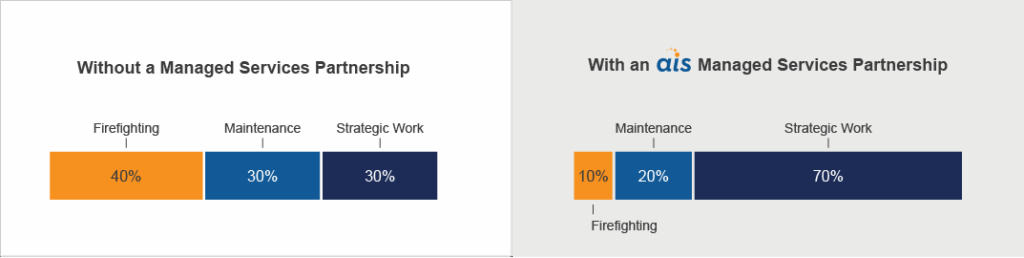
- Free up your IT team for innovation: Stop spending 70% of resources on firefighting and maintenance, instead channel that energy into strategic projects that drive growth and save hundreds of thousands annually.
- Turn risk into resilience: Address technical and compliance debt proactively to strengthen security, avoid costly breaches (which average $10.22M), and ensure compliance at a fraction of the cost.
Strategic Costs: The Competitive Ground You’re Losing
Innovation Delays Weaken Market Position
When IT capacity is consumed by tactical troubleshooting, strategic initiatives get perpetually delayed. Organizations leveraging managed services partnerships accelerate product launches and service rollouts by 20–30% through automation and streamlined processes. Companies with properly calibrated IT capacity adopt new technologies 60% faster than those constrained by maintenance burdens.
The competitive gap widens in predictable patterns:
- You’re building foundational infrastructure → They’re building market position
- You’re debating technology stacks → They’re signing customers
- You’re in month six of vendor evaluation → They’re launching version 2.0
The Opportunity Cost No One Calculates
Organizations that shift to managed services partnerships see IT operational cost reductions of 30–50% immediately, giving them capacity they can redirect to strategic initiatives rather than maintenance.
The cost of “delayed strategic opportunities” never appear in your budget, but your competitors are gaining market share. This is because most organizations budget for what they have, not what they need to execute their strategy and unlike operations costs that flatten over time, strategic opportunity costs compound.
The math most IT Leaders don’t show their CFO:
⬆️ You have a strategic initiative that could generate $3M annually
⬇️ But when it’s delayed by 18 months you incur $4.5M in lost revenue (before accounting for customers lost to competitors)
That single delay costs more than a multi-year managed services engagement.
Operational Costs: Recover Lost Capacity with SmartOps
Context-Switching: The Productivity Crisis
When IT teams constantly shift between strategic projects and operational emergencies, they pay a hidden productivity tax. Unplanned outages can cost thousands per hour in lost productivity and revenue, while SmartOps managed services prevent these disruptions through 24/7 monitoring and proactive maintenance. When infrastructure and operational firefighting shift to a managed services partner like AIS, internal teams see productivity improvements of 15–25% as they refocus on strategic work.
The hidden productivity tax:
➡️ 10-person team @ $150K per person (fully burdened rate)
➡️ Team Costs (fully burdened) = $1.5M
➡️ 40% time on unplanned work = $600K annually on firefighting
But the real cost? What doesn’t get built.
Shadow IT: When Business Teams Can’t Wait
When official IT capacity can’t meet business velocity, teams find workarounds. Marketing subscribes to analytics platforms because IT’s queue is six months deep. Sales adopts CRM tools because IT projects won’t start until next quarter. Product spins up cloud resources because infrastructure requests take weeks.
Shadow IT creates compounding costs:
- Security exposure from unsanctioned tools
- Duplicate licensing for redundant capabilities
- Integration debt that must be addressed later
- Ongoing support burden for disconnected systems
Strategic managed services can help IT teams keep pace with business needs, thus reducing enterprise costs associated with dispersed IT solutions.
Talent Retention: When Your Best People Leave
Your best engineers leave because they’re maintaining legacy systems instead of building. Turnover costs range from 50–200% of annual salary when factoring in recruiting, onboarding, and lost productivity.
Turnover Costs: 50-200% of Salary
➡️ For a $150K senior engineer: $75K – $300K per departure
The strategic cost? Those engineers could architect your AI strategy. Instead, they’re building it at your competitor.
Technical Costs: The Constraints You’re Accepting
Technical Debt and Security Vulnerabilities
Technical debt accumulates through architectural shortcuts, delayed upgrades, and compatibility workarounds. The strategic impact: technical debt constrains what’s possible for the future. You can’t build the modern API architecture your digital strategy requires because it won’t integrate with core systems.
The Security Cascade
Businesses without managed services face heightened exposure to ransomware, phishing, and malware attacks. Every day, 560,000 new malware threats emerge, and unmanaged systems lack the defenses managed services providers can deliver through integrated SOC (security operations center) practices. While your team evaluates whether a critical patch will break compatibility, threat actors are weaponizing that vulnerability. SmartOps with AIS is providing response in hours, not weeks. Organizations that partner with us for security see results on par with the market – where companies are seeing breach risks reduced by up to 60% through proactive monitoring and rapid response capabilities.

Driving Operational Excellence Through IT Managed Services
Our client needed high availability, rapid incident resolution, and scalable support for their platforms.
What Changes With the Right Partnership
Not all managed services partnerships solve these problems effectively. Traditional providers often force you into their processes, their tools, and Service Level Agreements (SLAs) optimized for their efficiency rather than your business outcomes. Strategic partnerships like AIS ,using our SmartOps framework, work with your business reality: adapting our team structure, tooling, and workflows to match how your organization operates and what your strategy requires.
If your compliance framework demands specific processes, we integrate with those requirements rather than asking you to adopt ours. If your business operates in cycles–seasonal peaks, quarterly releases, regulatory deadlines–our capacity scales with your actual needs, not predetermined SLAs.
The result is a partnership that feels like an extension of your team, not just another vendor relationship. Ticket closure rates, uptime monitoring, or SLA management isn’t the end goal, they are simply indicators to help us ensure we stay laser-focused on helping you achieve your business outcomes.
READY TO TRANSFORM YOUR OPERATIONS?
We’ll help you evaluate your current IT capacity against your business roadmap to identify where misalignment is costing you: strategically, operationally, and technically.