







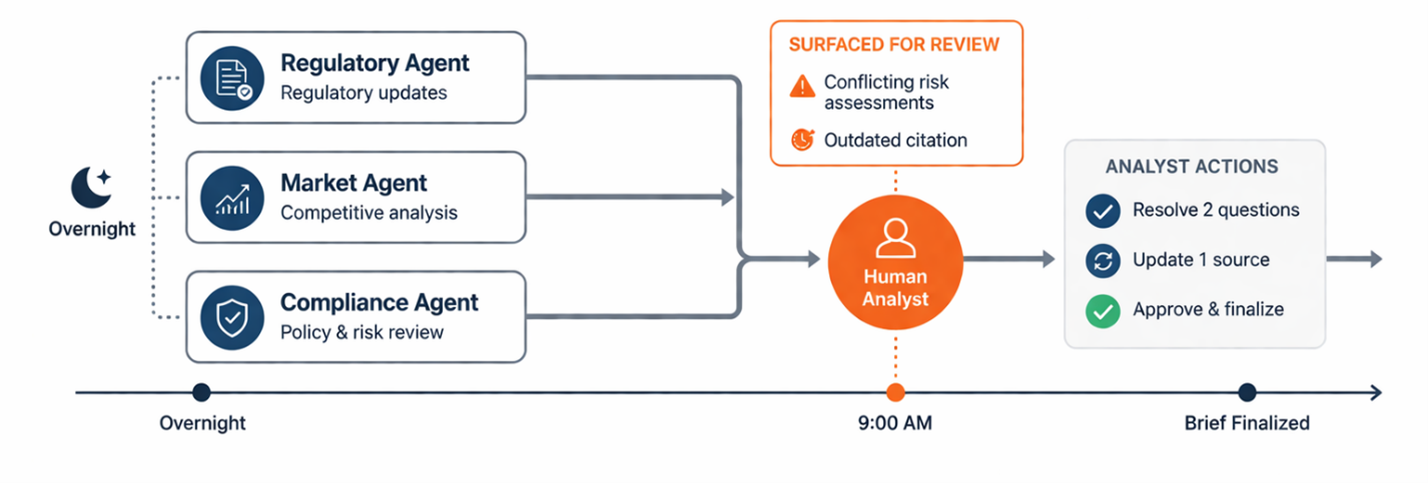
It’s Wednesday morning, and a strategy brief is due by Friday. Overnight, several specialist agents have already done their work. One pulled recent regulatory updates and summarized the key changes. Another analyzed competitive positioning using recent market data. A third reviewed internal policy documents to flag compliance risks.
By 9 a.m., the(human)Analystreviewsthedraft briefthat has been assembled. A few sections are highlighted where the agents reached different conclusions about market risk, and one citation needs to be replaced with a more recent source. The system surfaces these differences clearly and explains how each agent arrived at its recommendation.
The Analyst resolves two questions, approves the rest, and the brief moves forward.Several agents contributed to the work. But to the Analyst, it behaved like a single accountable system.
From Agent Pairs to Agent Orchestrators
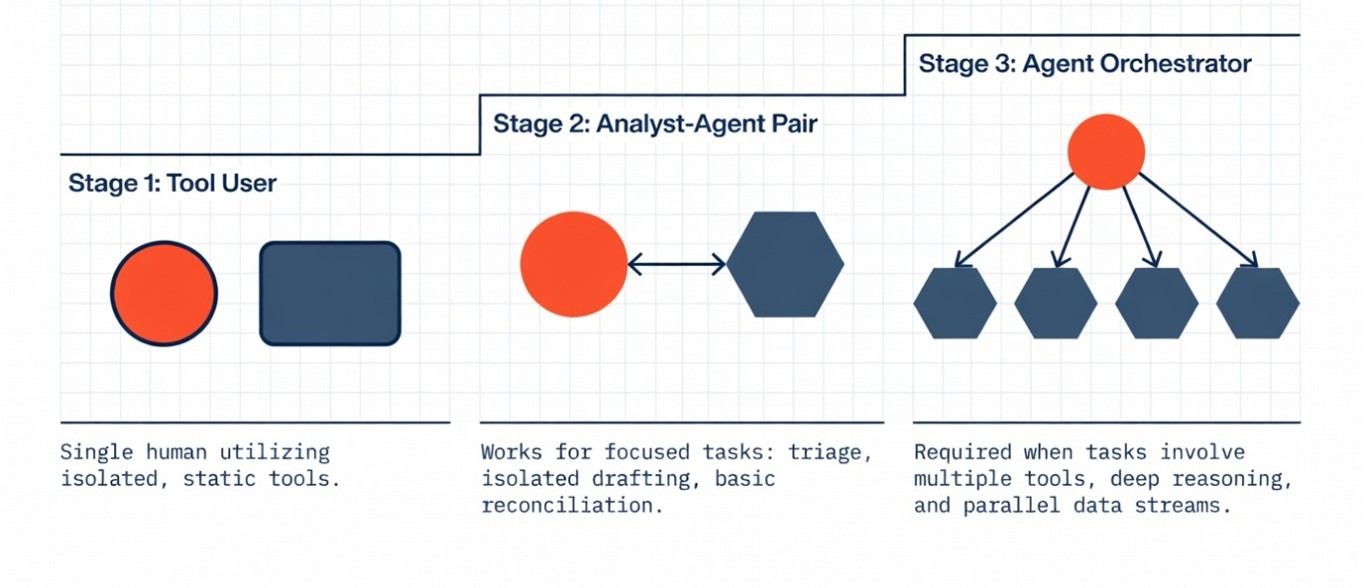
In a previous post, we described the Analyst–Agent Pair as a starting point for building reliable agentic workflows. When an agent is scoped appropriately, with clear goals, bounded tools, and explicit review points, it can reliably execute repeatable steps while a human expert steers the outcome. That pairing works well for focused tasks: research, drafting, triage, and reconciliation but can struggle with complexity.
As teams push these workflows further, the nature of the work changes. More tools become involved, tasks stretch across longer horizons, and varying expertise is required at different stages. A single agent that performs well within a narrow scope can struggle when asked to reason deeply, integrate multiple data sources, and manage parallel activities. When this happens, the challenge shifts from how to use an agent effectively to how to structure a system of agents so that specialized capabilities work together coherently.
Enter the Agent Orchestrator. Instead of interacting with one agent at a time, the human expert designs and steers a coordinated multi-Agent system. Agents are assigned specialized roles that allow for better performance. Work is delegated across the system, and outputs are compared, reconciled, and assembled into a final result. The human Analyst remains accountable for the outcome, but their effort shifts from task execution to structuring how the work happens.
If you have been following the progression we have described across these posts , from Tool User, to AI Collaborator (Analyst–Agent Pair), the Agent Orchestrator is the clear next step. The human is no longer managing a conversation with AI, they are designing an AI-enabled system that produces outcomes.
What an Agent Orchestrator Actually Does
The role is less about interacting with AI and more about designing the system around it. In practice, it breaks down into a few core responsibilities.
Defines the work. The orchestrator decides how a task should be decomposed. Research may be separated from analysis, validation may occur before synthesis, or risk-checks may run before a result is finalized. The goal is not more steps, but the right structure so that each part can be handled clearly and reliably.
Assigns roles. Different agents handle different kinds of reasoning. One gathers evidence. Another analyzes trends. A third synthesizes findings into a draft. In some workflows, an additional agent reviews output against policies or risk thresholds. Each agent has a narrow responsibility and a clear objective.
Designs handoffs. Each agent needs to know what it receives, what it produces, and when its role is complete. These handoffs allow the system to behave predictably because when the contracts between agents are clear, it becomes much easier to understand where something went wrong.
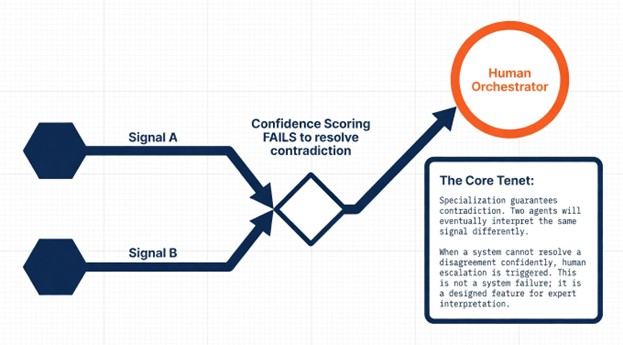
Reconciles disagreements. As agents specialize, contradictions appear and evidence may conflict. Two agents may interpret the same signal differently. The orchestrator surfaces these clearly rather than letting them get buried inside a single opaque response. Sometimes one source takes precedence and other times the decision escalates to a human.
Owns the outcome. Even when several agents contribute, human accountability does not disappear. Leaders remain responsible for the output, the reasoning behind it, and the decisions that follow.
In short, the orchestrator (human) is not simply using AI, they are designing how AI agents participate in the work.
The Advantages of Structured Workflow
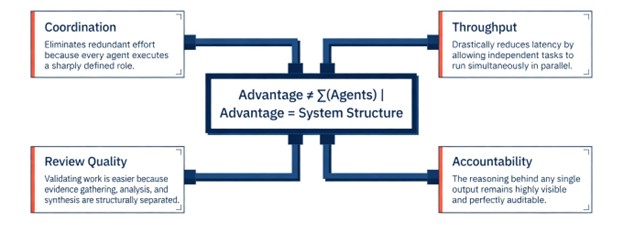
It is tempting to assume the advantage of multi-agent systems comes from having more agents. In reality, the advantage comes from how the work is structured. Without clear roles and coordination, additional agents can create confusion rather than capability.
Well-designed orchestration tends to improve four things: coordination (each agent has a clear role), throughput (independent tasks run in parallel), review quality (evidence gathering, analysis, and synthesis are separated and easier to validate), and accountability (the reasoning behind the output is visible and auditable).
Financial services teams are using structured agent workflows to assemble regulatory reports faster by separating research, reconciliation, and drafting into coordinated steps. Healthcare teams are using specialized agents to summarize clinical records and validate them against reference guidelines. Software engineering teams experimenting with specification-driven development are assigning agents to code generation, testing, and validation roles to reduce defects.
In each case, the advantage comes not from AI doing more work in isolation, but from structuring the system so that specialized capabilities work together in a way that humans can supervise and improve.
Design Questions Before You Compose a “Crew” of Agents
Once teams see what orchestrated agents can do, the instinct is to add more of them. The better starting point is the opposite. Before adding agents, decide where coordination actually adds value. A few design questions can clarify whether a workflow is a good candidate for orchestration:
What shape does the work take? Some tasks are linear and tightly coupled. Others break naturally into stages: gathering evidence, analyzing it, synthesizing a result, validating the outcome. Orchestration works best when the workflow has recognizable phases that can be separated without losing context.
What should run in parallel, and what should not? Research across multiple sources, competitive comparisons, or policy checks can often happen at the same time. Other steps should remain sequential, especially when one result depends on the interpretation of another.
Where does human judgment still matter most? The orchestrator’s role is not to remove human judgment but to position it where it adds the most value. That often means allowing agents to gather evidence and produce drafts while reserving key interpretation and approval points for the human expert.
What contradictions are likely to appear? When specialists analyze the same problem from different angles, disagreements are inevitable. Anticipating these early allows the system to surface them clearly rather than bury them.
Who owns the final output? Even when multiple agents contribute, someone must be responsible for the result, the reasoning behind it, and the decisions that follow.
What context should be shared and what should remain local? Some information benefits from being shared, such as common reference documents and prior decisions. Other information is better kept local to avoid noise or conflicting interpretations.
What are the stop conditions? When does the workflow produce a final result? When should the system escalate to a human? Without clear stopping points, multi-agent workflows can drift into unnecessary cycles.
None of these questions are particularly technical. But they help determine whether orchestration improves a workflow or just complicates it.
Reference Orchestration Patterns
Once the workflow is clearly structured, the next question is how agents should be coordinated. A few common patterns have emerged across frameworks and production systems. These are reference points, not prescriptions. The pattern should support the shape of the work, not define it.
Single orchestrator with specialist agents. A central orchestrator coordinates several specialists that each perform a narrow task: research, analysis, drafting, validation. This is the most common starting point. It keeps ownership clear and the workflow easy to follow. It can become a bottleneck if the orchestrator takes on too many responsibilities.
Hierarchical orchestration. Instead of a single coordinator, orchestration is layered. A top-level orchestrator manages intermediate agents, each coordinating its own set of specialists. This works for larger workflows that naturally break into subdomains. The risk is additional layers introducing more handoffs and more places where coordination can break down.
Shared workspace (blackboard model). Agents contribute to and read from a shared workspace. Instead of direct handoffs, work accumulates in a common context. This works well when multiple agents need access to the same evolving information. Without clear structure, the workspace can become noisy and agents may overwrite or reinterpret the same data.
Graph-based workflow execution. The workflow is modeled as a graph where nodes are agent tasks and edges define dependencies. Tasks execute when prerequisites are satisfied. This provides a clear view of progress and allows parallel execution, but can struggle with ambiguity or unexpected inputs.
Capability-based agent selection. The orchestrator selects agents dynamically based on their capabilities rather than following a fixed assignment. This allows the system to adapt as new agents or tools become available, though it can introduce unpredictability if capability definitions are vague.
For most teams, the simplest topology that supports the workflow is the right starting point. As the system evolves, the structure can expand to support additional specialization.
Common Failure Modes in Multi-Agent Systems
As teams experiment with multi-agent systems, a few failure modes appear quickly. Most come not from the technology itself, but from adding complexity without first designing the workflow that holds it together.
Agent soup. Many agents, no coordinating structure. Multiple agents contribute work, but no single unit owns the outcome. When something goes wrong, it is difficult to determine where the issue originated.
Routing mistaken for orchestration. Some systems route tasks to different agents based on rules or prompts. Routing alone is not orchestration. Orchestration requires planning, coordination, and reconciliation across multiple steps.
Unbounded fan-out. Delegating a task to too many agents at once produces a flood of partial results that are difficult to reconcile. This increases cost, latency, and review effort without improving the outcome.
Implicit handoffs. If dependencies between agents are not explicitly defined, assumptions creep in. Over time, hidden dependencies make the system fragile and harder to debug.
Human review added too late. When human oversight is bolted on only after the workflow is fully automated, review points tend to be awkward and ineffective. Human judgment is most effective when incorporated at the beginning.
The common thread: the biggest risks in multi-agent systems come from how the system is structured, not from the agents themselves. The question is not whether your organization is using multiple agents. The question is whether that coordination is happening intentionally or accidentally.
Handoffs, Contracts, and Reconciliation
If orchestration is the structure that allows multiple agents to collaborate, then handoffs, contracts, and reconciliation are the mechanics that make the collaboration reliable.
Each agent should know what it receives, what it produces, and what signals indicate its work is complete. Contracts may include structured inputs, required fields, or specific evidence that must accompany a result. When contracts are clear, agents can specialize without introducing ambiguity.
Evidence requirements matter as much as the contracts themselves. In most knowledge work, the output alone is not enough. The system must also surface the reasoning or sources behind it. This is especially important when multiple agents contribute to a final result: evidence allows the orchestrator and the human reviewer to understand why a particular conclusion was reached.
Context boundaries also need to be deliberate. Not every agent needs access to the same information. Some context should remain local to a specific task, while other information should be shared across the workflow. When boundaries are clear, agents operate efficiently without introducing noise.
Even with strong contracts and clear context, disagreements will still occur. Reconciliation defines how the system resolves these differences. In some cases, one agent’s output takes precedence. In others, the orchestrator compares confidence levels or supporting evidence. When the system cannot resolve a disagreement confidently, it escalates to a human decision point. That escalation is not a failure. It is a recognition that certain decisions benefit from expert interpretation.
Conclusion
The real advantage of multi-agent systems is the structure of the workflow that allows agents to coordinate, specialize, and produce accountable results.
For technology leaders, the shift is significant. The value your teams create increasingly comes from designing how the system works: how work is decomposed, how responsibilities are assigned, how results are reconciled, and where human judgment is applied.
This is the role of the Agent Orchestrator. This is how the system in the opening story becomes possible. And for most organizations, the question is not whether you will get there, but how deliberately you build toward it.